

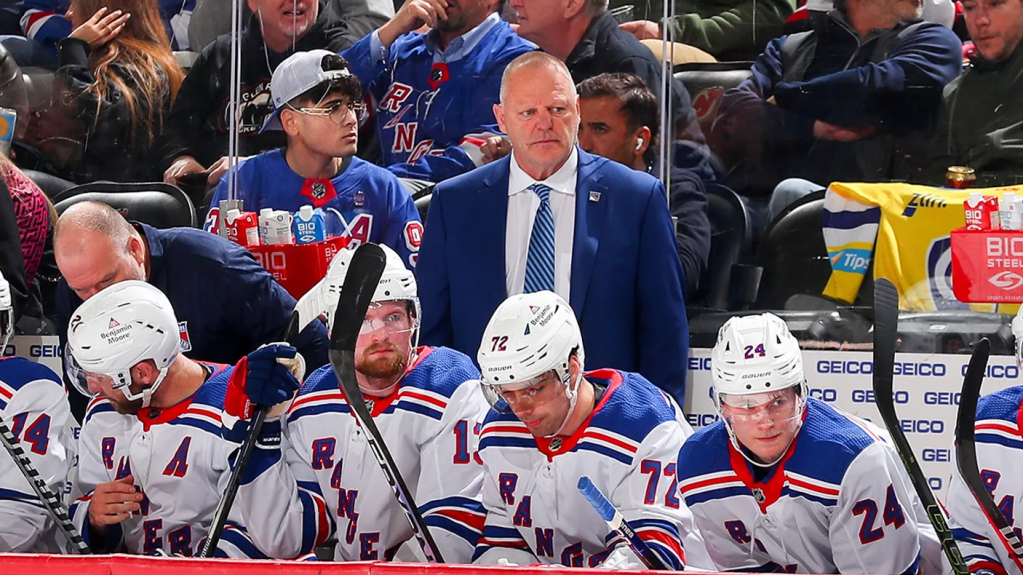
After closely observing the 7-game series against the New Jersey Devils, it became clear to management, players, and the fanbase that changes needed to be made. Gerard Gallant and his coaching staff were out-coached as the series progressed, failing to make meaningful adjustments. In the below article, I dive into the significance of coaching strategies in the Stanley Cup Playoffs and highlight the missed opportunities by the New York Rangers’ coaching staff as well as draw some parallels between preparing for a Stanley Cup Playoffs series and Special Forces mission planning.
During the first two games of the series, the Rangers dominated with consecutive 5-1 wins, thanks to their power play, strong goaltending from Igor Shesterkin, and some subpar goaltending from Vitek Vanecek. However, Lindy Ruff and Andrew Brunette of the Devils quickly adjusted their tactics and never looked back. They switched goaltenders, implemented a new penalty kill strategy, and relied on a relentless forecheck and neutral zone pressure to stifle the Rangers’ offense. They used team speed, something that the Rangers lack, to convert turnovers into Grade A scoring chances against Igor Shesterkin.
In contrast to the Devils’ adaptations, the Rangers’ coaching staff failed to make significant strategic changes. Aside from rotating players throughout the lineup, no meaningful adjustments were made. In the Stanley Cup Playoffs, coaching becomes increasingly vital as each game holds greater importance. Unlike the regular season, where general game plans suffice, the playoffs require meticulous attention to detail. Specific strategies are crafted to counter opponents’ tactics, and even the smallest nuances are exploited to gain an edge. The Rangers never seemed to have an answer for the changes the Devils made. How many times did you see a Rangers player attempt to skate the puck through the neutral zone, only too fail? How many times did you see an East to West pass picked off and turn into a dangerous scoring chance against? I do not think the New Jersey Devils were a significantly better team than the Rangers (just look at their next series against a starless-Carolina Hurricanes), but I do think they made the better adjustments and that ended up making all the difference.
Similarly, in Special Forces training scenarios, thorough planning becomes paramount when mimicking real-world missions. In-depth mission planning involves senior and capable individuals, such as the Team Sergeant, Captain, and Warrant Officer, who provide guidance to less-experienced team members. An entire week can be spent in isolation, planning for every contingency, studying the enemy in excruciating detail, and creating your own plan of action. Everything is rehearsed until each team member knows his own role inside and out. The same can be said for the disparity between the regular season and the Stanley Cup Playoffs in hockey. The NHL coaching staff is responsible for preparing teams for the demanding grind of the NHL playoffs and ensuring they are well-prepared to face their opponents. There should be hours of video sessions on the opponent, preparing for every eventuality, learning the habits of the other teams star players, and how to exploit them.
A good example of this would be this year’s Stanley Cup Finals. It became apparent, that when traffic increased in front of the net, Sergei Bobrovsky would crouch down low in order to look around player’s legs in an attempt to find the puck. In doing this, he became increasingly susceptible to pucks being shot up high around his shoulders and the top corners of the net. The Vegas Golden Knights’ coaching staff had obviously keyed in on this detail and briefed it to their players going into that series. The Knights’ players scored a number of goals from distance by throwing pucks high at the net, catching Bobrovsky crouching low to the ice. Little minute details like this can make all the difference in a series when both teams are equally matched. I am by no means accusing the New York Rangers coaching staff of not preparing for their series. However, once a series begins it is a game of adjustments, game to game, shift to shift. If you cannot respond, the other team will learn and take advantage of you.
It has been discussed in many podcasts and articles from people with knowledge of the organization like Valiquette, Brooks, and Arthur Staple that Gallant did not engage in much teaching or coaching during the regular season or playoffs. Young players like Lafrienere, Kakko, Chytil, and Schneider require guidance and constant refinement of their game. Few rookies can seamlessly transition into the NHL without ongoing teaching and development. Even some veterans expressed dissatisfaction with the lack of guidance from the coaching staff. It is imperative for coaches to provide strategies and support to nurture and maximize player potential.
In light of the shortcomings in coaching strategies, the decision to part ways with Gerard Gallant was necessary. While he was the right fit for the Rangers two years ago following David Quinn’s departure, the team now requires a coach who strikes a balance between allowing players to showcase their skills and intervening when necessary.
The New York Rangers’ playoff series against the New Jersey Devils underscored the importance of effective coaching adjustments. In the crucible of the Stanley Cup Playoffs, strategic adaptations can make all the difference between victory and defeat. The coaching staff’s role becomes pivotal in preparing the team and responding to opponents’ tactics. By recognizing these critical factors, the Rangers can lay the foundation for success in future playoff runs.
 GreenHatBlueShirt
Leave a comment