

In the following article, I will recount the timeline of coaches the Rangers have had since the early 2000s, using this article as a stepping stone for my next one. We will go in depth on what each coach brought to this team and how their triumphs and failures have led the Rangers to where they are today. In the future article, I will take a deep dive into the current coaching staff and what each will bring to the roster.
As the storied history of the New York Rangers unfolds, the impact of their coaching staff cannot be overstated. Over the past two decades, the team’s coaching carousel has witnessed ups and downs, with each coach leaving an indelible mark on the franchise’s journey. In this retrospective, we revisit the pivotal coaching changes and explore their role in the Rangers’ pursuit of another deep Stanley Cup run and ultimate triumph.
I would like to start this out with a disclaimer. I have only been watching the Rangers for 19 years. Unfortunately, I was born in 1993, I was too young to enjoy the glory days. Fortunately, I was also pretty lucky. I just barely missed out on what I’ve seen many Ranger’s fans call, “The Dark Years”. The early 2000s, when the Rangers earned a reputation for going big name hunting in free agency, dolling out massive contracts for high-profile free agents and veterans past their prime, rather than investing in player development and nurturing young talent. These expensive signings often failed to live up to expectations, resulting in a lack of team chemistry and on-ice success. Luckily, I happened to tune in right as the winds of change began to blow.
Embracing Change: The Tom Renney Era
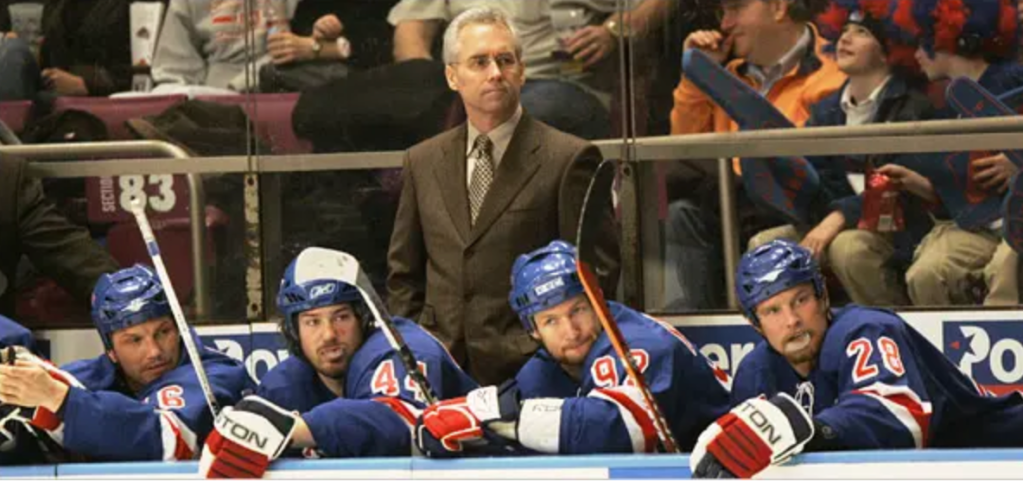
Tom Renney
From left to right:
Sean Avery, Ryan Hollweg, Michael Nylander, Colton Orr
Tom Renney was hired prior to the 2004-2005 season and ushered in a new era for the New York Rangers. Yes, he may have been a little boring, and yes he placed an emphasis on defensive structure, but under his leadership the Rangers underwent construction to become a competitive team again. Renney was focused on player development and building the right habits. During his tenure, Renney helped develop key players like Henrik Lundqvist, Ryan Callahan, Dan Girardi, and Marc Staal, who would become crucial pieces of the Rangers’ roster in the years to come. Although he ultimately never realized true success during his time in New York (the Rangers never made it out of the second round of the playoffs), Tom Renney built the foundation that later Rangers teams would build upon to become one of the most successful teams from 2010 onwards.
The Tortorella Era: A “Blue Collar” Mentality
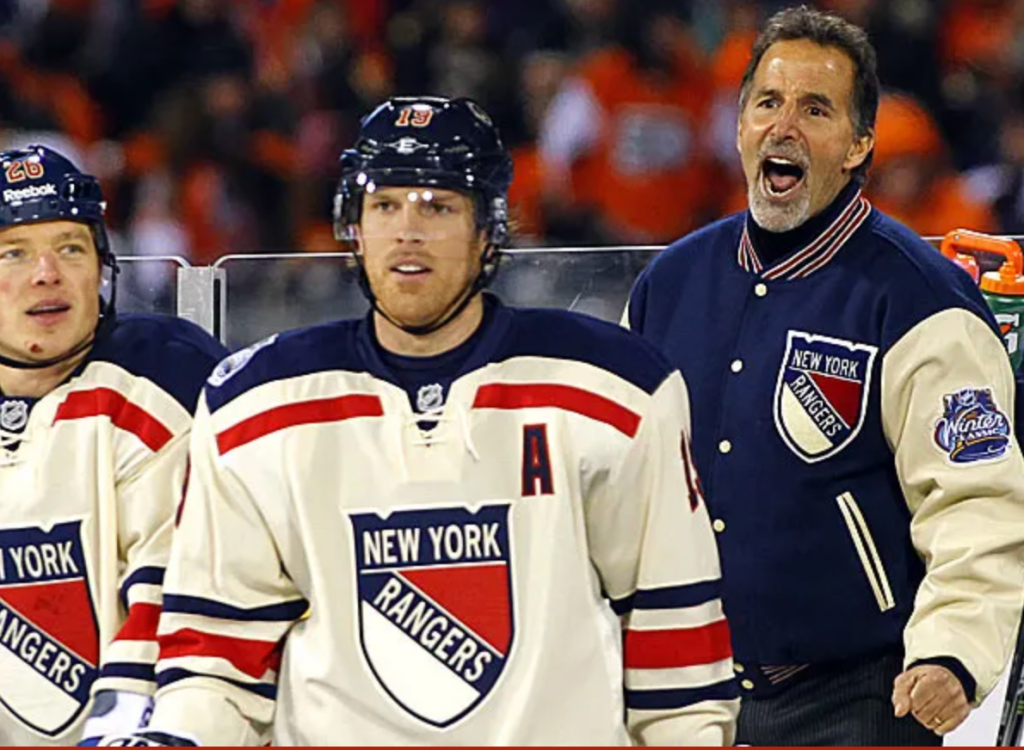
From the 2012 NHL Winter Classic between the New York Rangers and Philadelphia Flyers.
If Tom Renney was boring or ‘forgettable’, his successor was his extreme counterpart. Following Renney’s reign, the Rangers found a fiery and passionate leader in John Tortorella, who took over during the latter part of the 2009 season. Known for his intense coaching style, Tortorella instilled a “blue-collar” work ethic in the team. He placed a strong emphasis on defensive play, shot-blocking, and physicality. The Rangers embraced a gritty style of play, earning the nickname, ‘the Black and Blueshirts’. These years were defined by some successes, but also by having one of the tougher teams in the NHL, rolling out the likes of Mike Rupp, Derek Boogaard, Brandon Prust, Sean Avery, Michael Sauer, Stu Bickel, and Arron Asham. While I will not argue that it is more important to have a skilled team than a tough team, especially in today’s NHL, I would be lying if I said I didn’t enjoy every last minute of those years. Who remembers those rivalry games with the Devils?
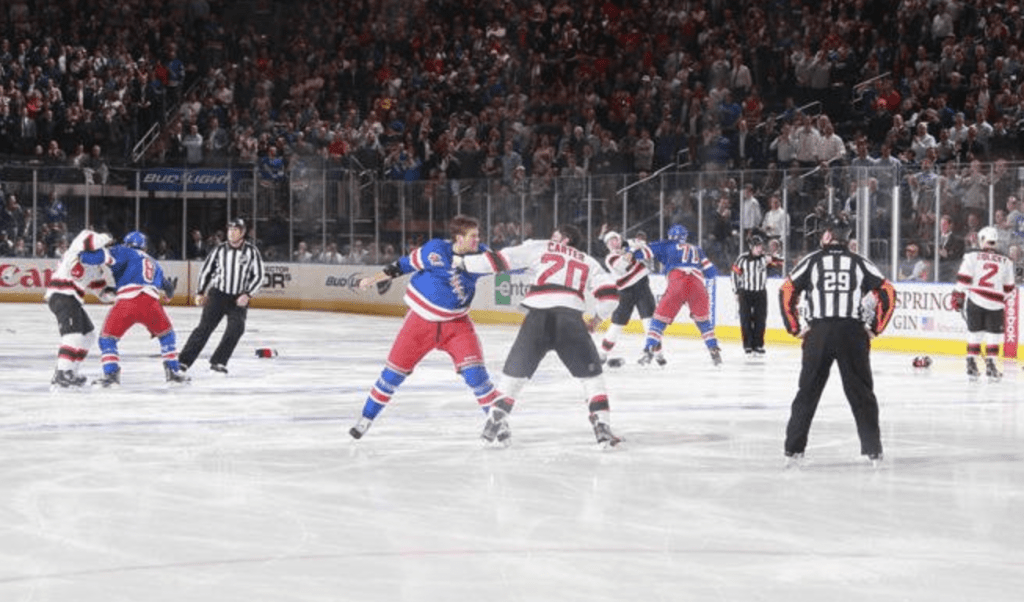
Infamous Rangers vs Devils brawl off of the opening face-off
Along with the fire and passion, came a bit of his own controversy as well. Never one to be shy or bashful, he was known to have it out with his players in the locker rooms, in practice, even on the bench in the middle of games. His post-game press conferences were often candid and colorful, earning him a reputation as a blunt and outspoken coach. I think everyone remembers the battles between him and New York Post editor Larry Brooks. Does getting beaten up at a bus stop ring a bell?
Despite all that, Tortorella’s impact was undeniable. In his first full season, the Rangers clinched a playoff berth, eventually bowing out in the first round to the juggernaut Washington Capitals. The team’s style of play became more aggressive and defensively responsible. Under his leadership, the Rangers secured the Presidents’ Trophy in the 2011-2012 with a 51-24-7 record, boasting their best regular-season performance in years. A deep playoff run followed. Tortorella lead the team to the Eastern Conference Finals for the first time since 1997, where they valiantly battled the New Jersey Devils, ultimately being eliminated in a grueling six-game series. As with all hard-nosed, ‘barker-esque’ coaches, John Tortorella had a shelf life. After losing in the second round to the Boston Bruins during the 2013 Stanley Cup Playoffs, the Rangers fired Tortorella. They were looking to move to a more offensive oriented approach.
Vigneault’s Offensive Emphasis and Heartbreaks

As Benjamin Franklin once said, in this world, nothing is certain but death, taxes, and the NHL coaching pendulum swinging back and forth. As is tradition, after the barker-type coach departs, the ‘player’s coach’ gets hired. In 2013, the Rangers embarked on a new journey with the appointment of Alain Vigneault. Known for his composed demeanor and emphasis on offensive creativity, Vigneault’s approach was widely embraced by players and fans alike. The Rangers saw an immediate impact, reaching the Stanley Cup Finals in his inaugural season. Although they faced a heart-wrenching defeat in 5 games at the hands of the Los Angeles Kings, it was a fiercely contested series. I may be biased, but this was the closest 5 game series I have ever watched, with three of their four loses going to overtime, two of those being double overtime. The pain of watching ‘The King’ face down on the ice never subsides.
The next year, Vigneault led the team to their second President’s Trophy win, in the last 4 years, as the best regular season team in the NHL. Another deep playoff run ensued, where they once again came up short, this time in 7 games to the soon-to-be juggernaut Tampa Bay Lightning. Another heart-breaker for Henrik Lundqvist.
Despite Alain Vigneault’s early success with the Rangers, the tail end of his time in New York was the equivalent of watching a sinking ship. The next couple years were marked by good regular seasons, followed by disappointing post-season losses to the Pittsburg Penguins and Ottawa Senators. In 2018, with an aging veteran core and a bleak future, the Rangers sent out “The Letter” to the fanbase, signaling the desire to begin a rebuild and a commitment to the future. Alain Vigneault was subsequently fired at the end of that season, opening the way for a coach who was supposed to guide the Rangers through their re-building years.
Quinn’s Rebuilding Vision and Unforeseen Challenges
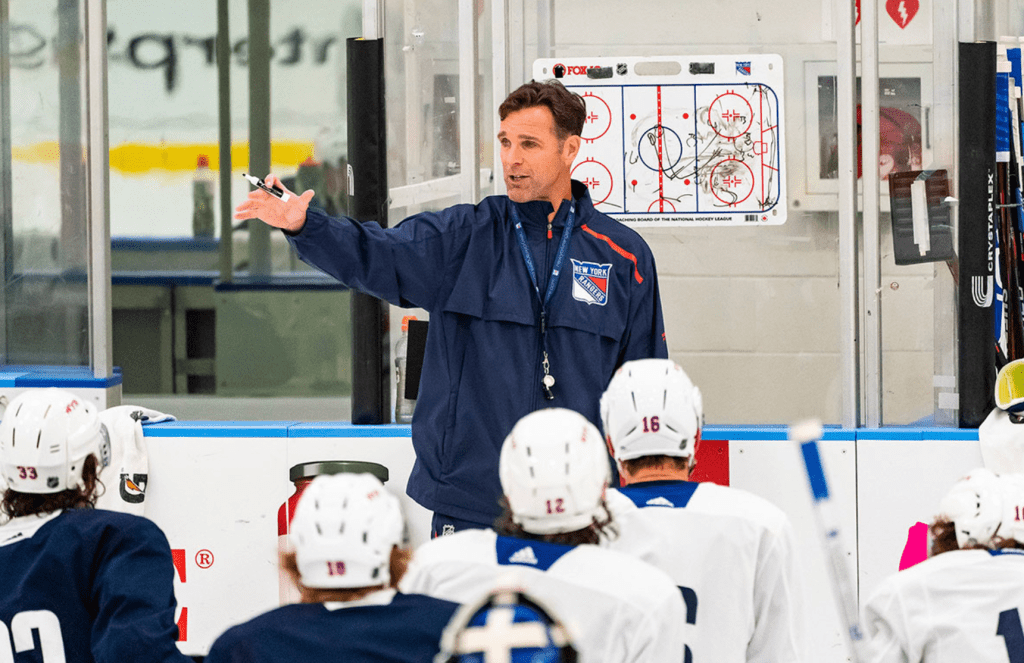
Enter David Quinn. The Rangers plucked him from Boston University, which at the time seemed perfect. He had just spent five years coaching at the collegiate level, the natural assumption being that he would be a great fit to usher in the Rangers prospects and help develop them into another Stanley Cup contending team. But somewhere along the way, wires got crossed leading to the eventual firings in the front office. Most of this stems from James Dolan, the New York Rangers owner. It is well known that he is an impatient owner who likes to get his hands all over his organizations (see the New York Knicks). For many years, Glen Sather was able to ward him off, keeping his imprint away from the Rangers. But after the Tom Wilson debacle, Dolan went on a rampage, firing GM Jeff Gorton and Team President John Davidson.The upheaval in the front office ultimately impacted Quinn’s tenure, leading to his dismissal after just three seasons. How quickly the rebuild had changed into high expectations again. Just three years after The Letter was released, Dolan wanted the Rangers to be in win now mode again and David Quinn’s Rangers were underperforming in his eyes. New General Manager Chris Drury felt the heat and decided they needed to bring in a veteran coach who had a track record of success in his first years as a head coach for organizations.
The Gallant Era and Looking to a Bright Future
This leads us to Gerard Gallant and the previous coaching staff. Having just done an article on everything that went wrong there, I don’t feel the need to rehash that story. However, this does leave us at a point where we can look forward to the future and next season. In my opinion, next year’s coaching staff represents the most promising group seen in two decades or more. In an upcoming article, we will delve into the background of each coach, analyze their unique attributes, and explore the potential they hold in guiding the Rangers towards a triumphant return to Stanley Cup contention.
 GreenHatBlueShirt
Leave a comment